
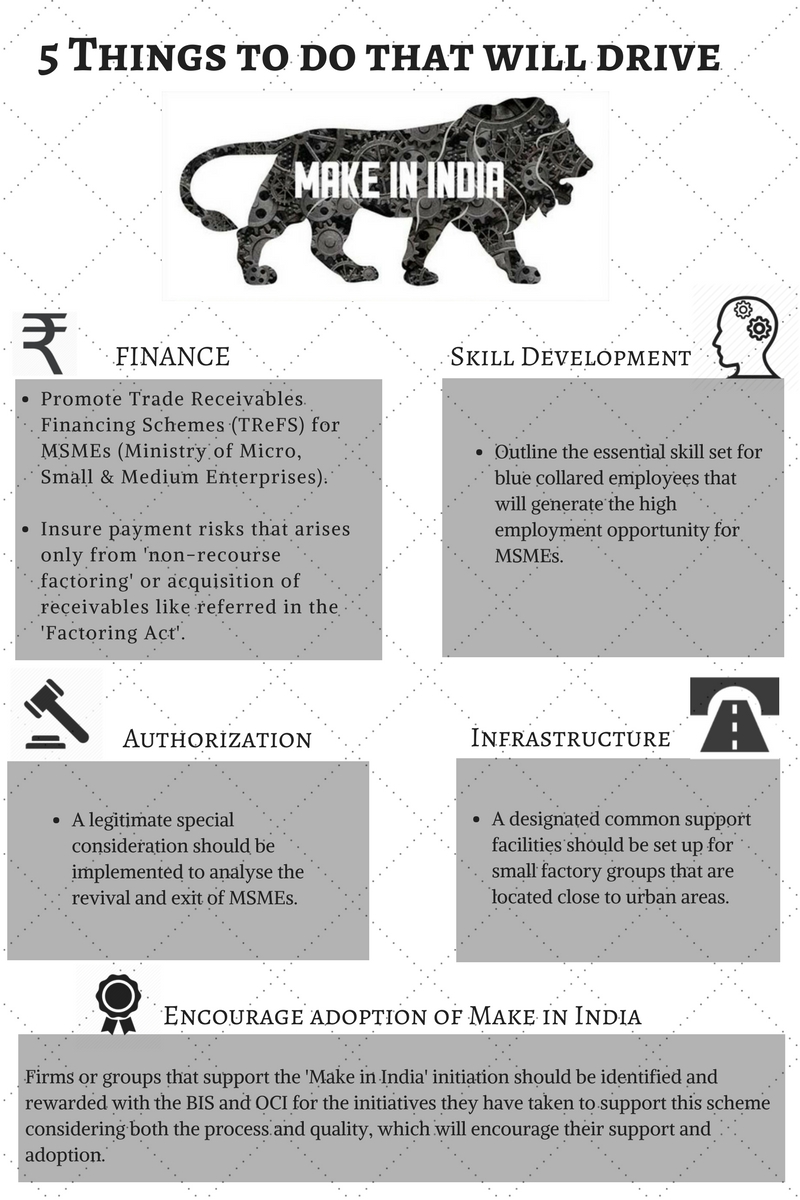
Perhaps the most important proposal for the renovation of India’s financial future was the NDA(National Democratic Alliance) government’s proposal to make ‘Make in India’. I as a citizen thought it was a excellent idea, for it would mean the government would focus on the improvisation of India’s capacity to produce , whether it be goods or services, either for the domestic economy through import substitution , or for the global economy through exports. I thought it’s becoming important to clarify that making in India did not necessarily mean selling primarily to the export markets . Given both slow global growth as well as increasing protectionism, we should not rule out making for the large and vibrant Indian market. In the short run we would probably make in India , largely for India. The longer run could be different, depending upon the circumstances developed.
The global economy is still weak, despite a strengthening recovery in the United States. The euro area is changing it’s direction suddenly close to recession , Japan has already experienced two quarters of negative growth after a tax hike, and many emerging markets are rethinking their export-led growth models as the industrial world stagnates. In the last couple of years IMF has repeatedly reduced it’s growth forecasts. After six years of a tepid post-crisis recovery , the IMF titled its most recent world economic outlook.
WHAT ABOUT EMERGING MARKETS?
Slow industrial country growth has made more difficult a traditional development path for emerging markets – export -led growth. Indeed, in the last decade , even as China developed on the back of it’s exports to industrial countries , other emerging markets flourished as they exported to China. Emerging markets have to now again rely on the domestic demand, always a difficult task because of the temptation to emerging overstimulate. That task has become more difficult because of the abundance of liquidity sloshing around the world as a result of ultra-accommodative monetary policies in industrial countries. Any signs of growth can attract foreign capital , and if not properly managed, these flows can precipitate a credit and asset price boom and exchange rate overvaluation. When industrial country monetary policies are eventually tightened, some of the capital is likely to depart emerging market shores. Emerging markets have to take extreme care to ensure they are not vulnerable at that point. What implications should an emerging economy like India, which has weathered the initial squalls of the ‘Taper Tantrums’ of the summer of 2013, take away for it’s polices over the mediums term? I would focus on three: 1) Make in India; 2) Make for India; 3) Ensure transparency and stability of the economy.
LESSONS FOR INDIA
- MAKE IN INDIA. The government has the commendable aim of making more in India. This means improving the efficiency of producing in India, whether of agricultural commodities, mining, manufacturing, or services. To achieve this goal , it has to implement it’s ambitious plans for building out infrastructure. A second necessity for increasing productivity in India is to improve human capital. This requires enhancing the quality and that people are healthy and able. People also need better and more appropriate education, skills that are valued in the labour markets, and jobs where firms have the incentive to invest more in their learning.
- MAKE FOR INDIA. If external demand growth is likely to be muted, we have to produce for the internal market. This means we have to work on creating the strongest sustainable unified market we can, which requires a reductions in the transactions costs of buying and selling throughout the country. Improvements in the physical transportation network will help in the cases but to those only who are efficient and competitive intermediaries in the supply chain from producers to the consumers. A well designed GST bill, by reducing state border taxes, will have the important consequence of creating a truly national market for goods and services, which will be critical for our growth in years to come.
- ENSURE TRANSPARENCY AND STABILITY OF THE ECONOMY. Now even developed countries like Portugal and Spain have been singularly unable to manage domestic demands. Countries tend to overstimulate, with large fiscal deficits, large current account deficits, high credit and asset price growth, only to see growth collapse as money gets tight. The few countries that have avoided such booms and busts typically have done with sound policy frameworks. As a country that does not belong to any power blocks, we don’t ever want to be in a position where we need multilateral support. It will be all the more important to get our policy frameworks right. Clearly, a sound fiscal framework around a clear fiscal consolidation path is critical.
 chandel's finance blog